RV Solar
Solar Power for RV Air Conditioner: What It Really Takes (2026 Guide)
Informational guide · Full math with worked example · No products, no hype · October 2026
Short answer: yes, solar can run an RV air conditioner, but it is a big-system job, not a weekend-kit job. An air conditioner is the hungriest appliance in an RV by a wide margin, and the math is unforgiving: running watts times hours gives you a battery bank several times larger than a typical setup, and recharging that bank takes a panel array several times larger still. This guide walks through the real numbers with a full worked example, explains startup surge and soft starters honestly, and lays out the alternatives for everyone who does the math and decides otherwise.
Affiliate disclosure: RV Solar Power Guide is reader-supported. When you buy through links on this page, we may earn a commission at no extra cost to you. Our picks come from comparing verified specs and price. We don't accept payment for placement.
The honest answer
Yes, it is possible. But 4 hours of a 1,500W AC needs about 6,000 Wh of battery and 1,600W of panels to recharge, far beyond a typical 200 to 400W setup.
Running watts
A typical 13,500 BTU unit draws roughly 1,500 to 2,000W running (illustrative). Check your AC nameplate; actual figures vary by unit and conditions.
Startup surge
Compressors draw several times their running watts for a few seconds at startup. This trips more inverters than the running load ever does.
The usual outcome
Most RVers run everything else on solar and reserve a generator or shore power for the air conditioner.
01The honest answer up front
Yes, solar power can run an RV air conditioner. People do it. But the systems that do it look nothing like the 200 to 400 watts of panels and single 100 Ah battery that most weekend campers carry. They look like 1,500-plus watts of panels, 500-plus amp-hours of lithium, and a large inverter, which is a different project in size, weight, and cost.
The whole question reduces to three links in a chain, and every link has to hold:
- Running watts × hours = battery energy. A 1,500W air conditioner running 4 hours needs 6,000 watt-hours of usable battery energy, before inverter losses.
- Battery energy ÷ sun = panel array. Replacing those 6,000 watt-hours on a 5 peak sun hour day takes about 1,600 watts of panels, before anything else in the RV is powered.
- Startup surge = inverter. The compressor's startup spike, several times the running watts, has to fit inside the inverter's surge rating or nothing starts at all.
If any link fails, the air conditioner does not run. Most of the disappointment in this topic comes from sizing one link and forgetting the other two. The rest of this guide sizes all three with real numbers, then shows the alternatives for everyone who reads the numbers and decides the juice is not worth the squeeze.
02What an RV air conditioner actually draws
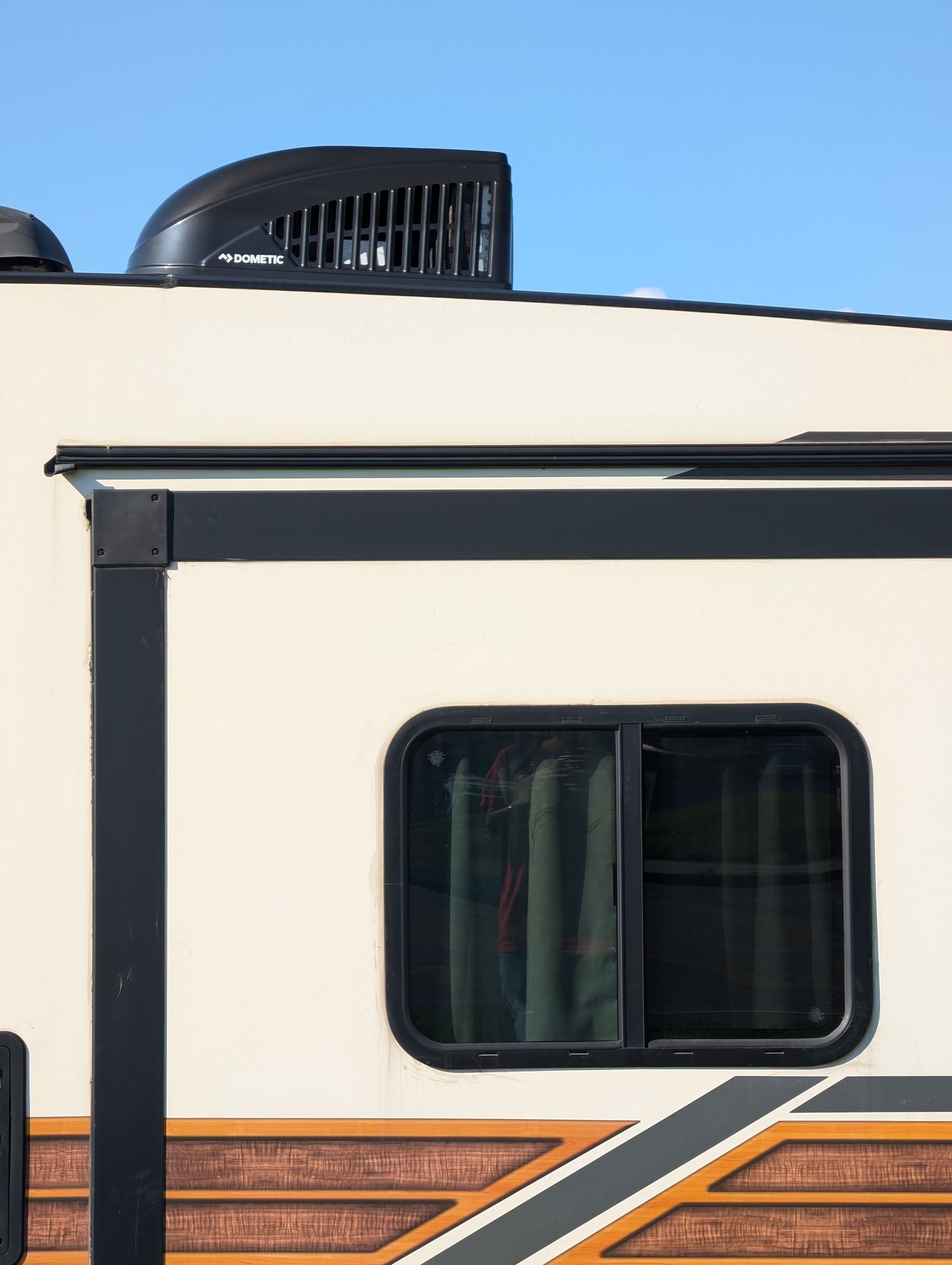
Rooftop RV air conditioners are rated in BTUs, but what matters for your electrical system is watts. As an illustrative range, a typical 13,500 BTU rooftop unit draws roughly 1,500 to 2,000 watts while running, with a much larger spike at compressor startup. For a real-world anchor, the Dometic Brisk II 13,500 BTU unit is listed at 1,670 watts power consumption. Smaller 9,000 to 11,000 BTU units draw less, which is why they show up later in this guide as the realistic option.
Treat every number in that paragraph as illustrative, not as a specification for your unit. Actual running watts depend on the exact air conditioner, its compressor, ambient temperature and humidity, fan speed, and how hard the unit is working. The nameplate or manual on your specific air conditioner is the only number you should size from. If you are shopping for a unit with solar in mind, its rated running watts and its locked-rotor or startup current are the two figures to compare.
| Unit size (illustrative) | Typical running watts | 4 hours of cooling |
|---|---|---|
| 9,000 to 11,000 BTU | Lower than 13,500 BTU units; check nameplate | Smallest battery and panel requirement |
| 13,500 BTU | Roughly 1,500 to 2,000W | Roughly 6,000 to 8,000 Wh |
| 15,000 BTU | Higher; check nameplate | Largest requirement of the three |
One more thing the table hides: air conditioners cycle. The compressor runs, the thermostat is satisfied, the compressor stops, and the fan may keep going. Over an afternoon theaverage draw is lower than the running watts, but you must size the battery and inverter for the running watts and the surge, not the average. Sizing for the average is how systems end up tripping on the hottest hour of the day.
03Startup surge and soft starters
Here is the part that surprises people who have only done the running-watts math. When the compressor kicks on, it draws several times its running watts for a few seconds. A unit that runs at 1,500W can easily demand 4,500 to 7,500W at the instant of startup. That spike is what the inverter's surge rating has to absorb, and it is the most common reason an otherwise adequate-looking system trips the moment the AC tries to start.
This is where soft starters enter the conversation. A soft starter ramps the compressor up gradually instead of slamming it on at full inrush, which can bring the startup spike down into a range a large inverter's surge rating can handle. What a soft starter does not do is reduce running watts: once the compressor is up to speed, the air conditioner draws exactly what it always drew.
Two honest caveats. First, compatibility must be confirmed with both the soft starter maker and your air conditioner manufacturer for your specific unit; no soft starter is guaranteed to work with every AC. Second, a soft starter shrinks the inverter problem but changes nothing about the battery and panel math in section 04. You still need the energy.
04Worked example: 4 hours of cooling on paper
Assumptions, stated up front: 12V nominal system throughout, a 1,500W running draw (illustrative), 4 hours of afternoon cooling, 5 peak sun hours for recharge, and a 0.75 system performance factor. Substitute your own AC's nameplate watts, your hours, and your sun hours.
Step 1: the energy
1,500W × 4 hours = 6,000 Wh of usable battery energy, before inverter losses. Real consumption is higher once the inverter's inefficiency is included, so treat 6,000 Wh as the floor.
Step 2: the battery bank
6,000 Wh ÷ 12V = 500 Ah of usable capacity. For lithium at about 90 percent usable per the battery manufacturer's specification, that is 500 ÷ 0.90 = 555.6 Ah nominal, so roughly 560 Ah. Battery banks come in standard sizes, so in practice you are looking at a 600 Ah lithium bank to run this example with any margin. For scale, that is six times the 100 Ah battery in a typical weekend setup.
Step 3: the inverter current
1,500W ÷ 12V = 125A from the battery before inefficiency, and the real draw under load is higher. The inverter's continuous rating must exceed the running watts, its surge rating must cover the compressor startup spike (see section 03), and the battery bank must sustain 125A-plus without tripping discharge limits, which section 05 covers.
Step 4: the panels to recharge it
6,000 Wh ÷ (5 peak sun hours × 0.75) = 1,600W of panels, and that replaces only the air conditioner's energy. Everything else in the RV, lights, fridge, fans, needs panels on top of that. Compare 1,600W to the 200 to 400W on a typical weekend rig: 4 to 8 times as much, which is also far more than fits on many RV roofs.
That is the whole story in four steps. Nothing about it is impossible, but every step lands 4 to 8 times above a normal weekend solar setup, which is why the honest answer in section 01 is "yes, but."
05The battery bank reality
The worked example sized the bank by energy: 500 usable amp-hours. But amp-hours alone do not prove a bank can run an air conditioner. The bank has to store the energy and deliver the current, and those are separate requirements.
- Maximum continuous discharge current. Every battery has a rated maximum it can deliver continuously, in the manual. A bank that holds 6,000 Wh but can only deliver 100A continuously cannot feed a 125A air conditioner load.
- BMS limits. Lithium batteries have a battery management system that cuts discharge when current, temperature, or voltage goes out of bounds. Several smaller batteries in parallel share the current, but the per-battery limit still applies.
- Voltage sag. Under a heavy sustained draw, battery voltage drops. If it sags to the inverter's low-voltage cutoff, the inverter shuts off with energy still in the bank. Short, thick cables and a healthy bank keep sag manageable; long thin ones make it worse.
This is also why lead-acid struggles here beyond just the 50 percent usable rule. A 500 Ah usable requirement means 1,000 Ah of lead-acid nominal, which is enormously heavy, and lead-acid voltage sags harder under high sustained loads than lithium. For air conditioning duty, lithium is the practical chemistry, sized per the manufacturer's specifications. The sizing guide covers battery math in depth, and the inverter guide explains the current-draw relationship.
06What an AC-capable system actually looks like
Putting the pieces together, a system that genuinely runs a 13,500 BTU air conditioner off solar has roughly this shape. Nothing here is a product recommendation; it is a description of the scale involved.
- Battery bank: on the order of 500 to 600 Ah of lithium at 12V nominal for a few hours of cooling, more for all-night running. The bank's maximum continuous discharge current must cover the inverter's full draw with margin, per the battery manual.
- Inverter: a large pure sine wave unit whose continuous rating exceeds the AC's running watts and whose surge rating covers the startup spike, ideally with a soft starter on the AC. Both ratings verified in the manuals, never assumed.
- Panel array: on the order of 1,500W or more to recharge the day's cooling energy, plus whatever the rest of the RV uses. Roof space is often the binding constraint.
- Wiring and protection: high-current DC runs sized from the actual current and length, fuses close to the battery on every run, and a charge controller verified against the array's voltage, current, and power. The wiring diagram guide covers placement and connection order.
- Backup: most AC-capable builds keep a generator anyway, for cloudy stretches and the hottest weeks. The solar handles the mild days; the generator covers the extremes.
07Honest alternatives
Doing the math and deciding against solar AC is not failure; it is the most common rational outcome. Here are the alternatives people actually use:
- A generator for the AC, solar for everything else. This is the dominant real-world answer. The generator refuels and runs the air conditioner for as long as it has fuel; the solar system quietly handles lights, fridge, fans, and electronics. Split the jobs by what each does best.
- Shore power when it matters. If you camp where hookups exist on the hottest days, the whole problem disappears on exactly the days it is worst.
- Shade, ventilation, and timing. Parking in shade, running roof vent fans, and cooking outside cut the cooling load dramatically. Less heat in means fewer AC hours, which shrinks every number in section 04.
- A smaller or more efficient unit. A 9,000 to 11,000 BTU unit, or a high-efficiency mini-split style installation, draws less and surges less, so the entire system shrinks with it. Sometimes the cheapest watt is the one you never need.
- Running the AC while driving. The alternator contributes charging current with the engine running, which offsets some battery drain. How much help you get varies widely by RV, so treat it as a supplement, not a plan.
08Mistakes that kill the dream
- Expecting a 400W weekend setup to run the AC. The worked example needs 1,600W of panels just to recharge 4 hours of cooling. A 400W array replaces about a quarter of one afternoon of AC, on a good sun day.
- Sizing for running watts and forgetting surge. The compressor's startup spike is the number one inverter tripper. If surge is not in the math, the math is wrong.
- Buying amp-hours without checking discharge current. A bank that stores the energy but cannot deliver 125A continuously is a bank that shuts off at 2 p.m.
- No recharge plan. Running the AC off the bank is only half the system. Without enough panels to replace the energy, you get one good afternoon and then a dead bank.
- Modified sine wave on the AC. Compressor motors and control boards belong on pure sine wave. Check the AC manufacturer's guidance.
- Assuming a soft starter fixes everything. It tames the startup spike; it does not create energy. The battery and panel math does not change by a single watt-hour.
- Forgetting the roof. 1,600W-plus of panels needs serious roof real estate, planned around vents, skylights, and the AC unit itself. Measure before buying.
Frequently asked questions
How many watts does an RV air conditioner actually use?
As an illustrative range, a typical 13,500 BTU rooftop unit draws roughly 1,500 to 2,000 watts while running, and much more for a few seconds at compressor startup. For reference, the Dometic Brisk II 13,500 BTU unit is listed at 1,670 watts power consumption. Smaller 9,000 to 11,000 BTU units draw less. Actual figures depend on the exact unit, compressor, and conditions, so check your air conditioner's nameplate or manual.
How many solar panels do I need to run my RV air conditioner?
Far more than a typical weekend setup. As a worked illustration, 4 hours of a 1,500W air conditioner is 6,000 watt-hours, which needs about 1,600 watts of panels to recharge on a 5 peak sun hour day with a 0.75 system factor. That is 4 to 8 times the 200 to 400 watts most weekend campers carry. Your numbers will differ with your AC size, run hours, and local sun.
How long will my batteries run the air conditioner?
Divide your battery bank's usable watt-hours by the air conditioner's running watts. As an illustration, a 600 Ah lithium bank at 12V nominal holds about 6,480 usable watt-hours at 90 percent usable, which runs a 1,500W air conditioner for roughly 4 hours before inverter losses. Real runtime is shorter once inverter inefficiency and voltage sag are included, and the bank must also deliver the current without tripping its discharge limits.
Do I need a soft starter to run RV AC on solar?
A soft starter is often what makes the startup surge manageable: it ramps the compressor up gradually instead of slamming it on, which can bring the surge down into a range a large inverter can handle. It does not reduce running watts. Compatibility must be confirmed with both the soft starter maker and your air conditioner manufacturer for your specific unit; no soft starter is guaranteed to work with every AC.
Can I run the air conditioner at night on battery power?
Only if the battery bank was sized for it. Night running means no solar help, so the bank must hold the full night's energy and deliver the current. As an illustration, 8 hours of a 1,500W air conditioner is 12,000 watt-hours, which is about 1,000 usable amp-hours at 12V nominal, or well over 1,000 Ah of lithium nominal. That is a very large and heavy bank for most RVs.
Will a 2,000W inverter run a 13,500 BTU air conditioner?
Usually not on its own. A 2,000W inverter may cover the roughly 1,500 to 2,000W running draw, but the compressor's startup surge is typically several times the running watts, far beyond a 2,000W surge rating. A soft starter can reduce that spike, but you still need to confirm the inverter's continuous and surge ratings against your specific air conditioner's specifications in both manuals.
Should I just use a generator for the AC instead?
For most RVers, yes, at least for the air conditioner. A generator refuels and keeps running as long as it has fuel, which matches how air conditioning is actually used: long, sustained, high-draw cooling. Solar-plus-battery AC works, but it demands a very large and expensive system. Many off-grid RVers run everything else on solar and reserve the generator for the AC.
Can a smaller air conditioner run on a modest solar setup?
It is much more realistic. Smaller 9,000 to 11,000 BTU units and efficient mini-split style units draw less power and have smaller startup surges, so the battery bank, inverter, and panel array all shrink. Run the same math as the worked example in this guide with your unit's actual running watts and hours, and check the nameplate before sizing anything.
Does running the AC while driving help?
It can take the edge off, because the alternator contributes charging current while the engine runs, which offsets some of the battery drain. How much help you get varies widely by RV: alternator size, wiring, and whether the house battery charges from the alternator at all. It is a supplement, not a substitute for a properly sized bank and inverter.
Why does my AC trip the inverter on startup when the running watts look fine?
The compressor's startup surge is the culprit. For a few seconds at startup, a compressor can draw several times its running watts, which exceeds the inverter's surge rating and trips its protection even though the running load fits comfortably. This is the most common AC-on-inverter failure, and it is why surge ratings and soft starters matter more than running watts for air conditioners.
★The bottom line
Solar can run an RV air conditioner, and now you know exactly what that costs in equipment: roughly 6,000 usable watt-hours of battery and 1,600 watts of panels for 4 hours of cooling from a typical 13,500 BTU unit, plus an inverter whose surge rating survives the compressor kick, ideally with a soft starter. If those numbers fit your roof, your weight budget, and your plans, build it. If they do not, you are in good company: run the AC on a generator or shore power, put the solar toward everything else, and enjoy the quiet.
Either way, start with your real numbers. Run the full system math in the sizing guide, check the inverter guide for continuous and surge sizing, review wiring and fuse placement, and sanity-check it all with the RV solar calculator. And if any part of a high-current installation is unclear, a qualified RV technician checking your work costs far less than a fried inverter or a melted cable.