RV Solar
Pros and Cons of Bifacial Solar Panels for RVs (2026 Guide)
Informational guide · How bifacial works · Honest RV-specific pros and cons · Myths busted · October 2026
Short answer: bifacial panels capture light from both faces, but on a typical RV roof the rear side stares at dark roofing inches away, so the real-world bonus is usually single-digit percentages, not the "up to 30 percent more" in the marketing. They are genuine, durable panels that work fine on a camper; the question is whether the rear side earns its price premium on your particular roof. This guide explains how bifacial actually works, where the gains really come from, the honest pros and cons for RV use, when bifacial is worth it, and the myths that need killing.
Affiliate disclosure: RV Solar Power Guide is reader-supported. When you buy through links on this page, we may earn a commission at no extra cost to you. Our picks come from comparing verified specs and price. We don't accept payment for placement.
What bifacial means
Solar cells that capture light from the front and the rear. Rear output depends entirely on reflected light (albedo) reaching the back of the panel.
RV roof reality
Flush-mounted over a dark roof, rear gain is typically low single digits. RV owner testing shows roughly 5 to 10W extra on a 200W panel.
When it wins
White or light roof, tilt mounts, portable ground-deployed setups, snow country, or when the bifacial panel costs about the same as monofacial.
Electrical side
Identical to monofacial. Same charge controllers, same inverters, same wiring, same sizing. Mounting is the whole difference.
01How bifacial panels actually work
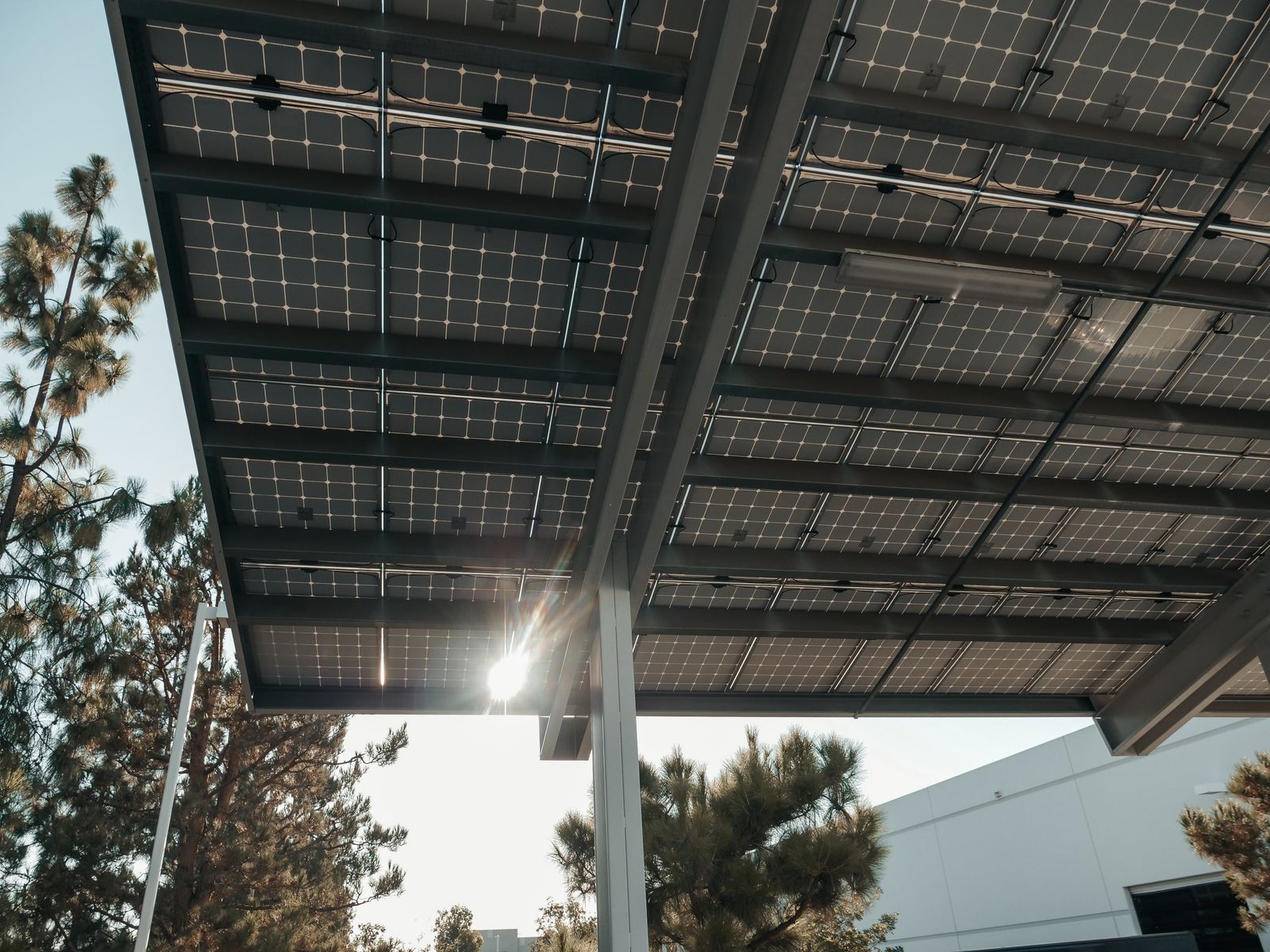
A standard (monofacial) panel has solar cells with an opaque backsheet behind them: light hits the front, and anything that gets past the cells is wasted. A bifacial panel replaces the backsheet with glass (or a transparent backsheet), so the cells can also collect light striking the rear face. That rear light comes from reflection off the surface below and around the panel, which is why the industry talks about albedo, the reflectivity of the surface under the array.
Two ratings matter. The nameplate wattage on a bifacial panel is the front-side rating under standard test conditions, exactly like a monofacial panel. The second number is the bifaciality factor: how efficient the rear side is relative to the front, typically around 70 to 80 percent for current PERC and TOPCon designs. But that factor is measured in the lab with the rear receiving the same full 1,000 W/m2 as the front. In the real world the rear gets a small fraction of that. NREL's multi-year bifacial test bed in Colorado measured full-year energy gains of 6.1 percent for PERC modules and 7.6 percent for silicon heterojunction modules, with early results up to 9 percent. Published field results otherwise range from low single digits on dark rooftops to around 10 to 20 percent in high-albedo, elevated setups.
Construction is usually glass on both faces instead of glass plus polymer backsheet. That dual-glass build is part of the durability story (section 02) and part of the weight story (section 03). Electrically, nothing changes: the panel puts out DC at its rated voltage and current, and it wires into the same controllers and inverters as any other panel.
02The real pros
- Free bonus energy where conditions allow. In manufacturer-published field tests with modules at 0.4-meter height and 27-degree tilt (Trina Solar test data), measured gains were about 24.6 percent over a white-painted surface, 11.8 percent over sand, and 5.7 percent over grass. NREL's own multi-year test bed measured full-year gains of 6.1 percent (PERC) and 7.6 percent (silicon heterojunction). On an RV these numbers shrink (section 04), but the physics is genuine.
- Excellent in snow country. Fresh snow has an albedo around 0.8, among the most reflective natural surfaces. Reflected light off snow feeds the rear side well, which is where bifacial gains peak in field testing. Winter campers on snowy ground get more from the rear than anyone else.
- Potentially tougher construction. Glass on both faces can resist moisture intrusion and backsheet UV degradation better than glass-plus-polymer builds, but real-world durability depends on the specific module design, build quality, certifications, mechanical loads, installation, and warranty terms. Some manufacturers claim 30-plus-year lifespans for dual-glass modules; treat those as manufacturer claims, not guarantees.
- Front-side performance is not sacrificed. A bifacial panel's front side is a modern high-efficiency cell (often N-type TOPCon) that performs like any good monofacial panel of the same wattage. You are not trading front-side output for the rear bonus; the rear is additive.
- Better diffuse-light behavior. Because the rear collects scattered and reflected light, bifacial panels pick up a little extra on overcast days and in the morning and evening shoulders relative to a monofacial panel in the same spot. It will not save a gloomy week, but the curve is slightly kinder.
- Price premium has shrunk. Industry analysis put the bifacial premium at 10 to 20 percent over monofacial in 2023, down from 30 to 50 percent a few years earlier. In RV sizes the gap varies by brand and retailer, but bifacial is no longer the luxury item it was, which changes the value math in its favor.
03The real cons
- Rear gain collapses on a typical RV roof. This is the big one, and it gets its own section below. Flush-mounted inches above a dark roof, the rear sees almost nothing. Expecting the marketed "up to 30 percent" on a standard RV roof is how buyers get disappointed.
- Heavier. Glass on both faces weighs more than glass plus polymer backsheet. On an RV, where roof load, payload limits, and one-person handling during installation all matter, the extra weight is a genuine con. Check the actual panel weight in the spec sheet; do not assume it matches a monofacial panel of the same wattage.
- Costs more per watt. The premium has shrunk but not vanished: about 10 to 20 percent more than comparable monofacial in 2023 industry analysis (BloombergNEF), down from 30 to 50 percent a few years earlier, though the actual gap varies by brand, retailer, and panel size. Paying more per watt for rear gain you cannot collect is the classic bifacial mistake.
- Needs mounting the RV roof does not want to give. Rear gain wants elevation (about a meter in ideal test setups), tilt, and open space behind the panel. A flat RV roof wants low-profile, aerodynamic, highway-safe mounting. These two goals fight each other, and the roof usually wins.
- Harder to predict. Front-side output is straightforward to model. Rear-side output depends on roof albedo, mounting height, tilt, rail shading, and even what is parked next to you. That makes payback math fuzzier than with monofacial, where what you see on the spec sheet is closer to what you get.
- Mounting hardware can shade the rear. Rails, brackets, and the junction box sit on the rear face. On a ground mount with open space this barely matters; on a tight RV roof install it eats into the already small rear bonus.
04Why RV roofs are the worst case for rear gain
Rear-side output needs three things: a reflective surface below, space between the panel and that surface for light to get in, and tilt so the rear face actually sees the reflected light. A standard RV roof install fails all three. The roof is usually dark EPDM rubber or aged TPO with an albedo around 0.05 to 0.1, meaning it absorbs roughly 90-plus percent of the light that hits it. Panels sit 1 to 3 inches above the roof on Z-brackets, leaving almost no gap for light to reach the rear. And flat mounting points the rear face straight down at that dark roof.
Here is what that means in numbers, as an illustration. Take a 200W bifacial panel with a 75 percent bifaciality factor:
- Dark roof, flush mount: rear gets maybe 5 percent of front-side light. 200 x 0.75 x 0.05 = about 7.5W extra. This matches what RV owners report in testing: roughly 5 to 10W of additional output from reflected light.
- White roof, tilted mount: rear gets maybe 15 percent of front-side light. 200 x 0.75 x 0.15 = about 22.5W extra, or roughly 11 percent. Respectable, and the tilt helps the front side too.
These are illustrative figures to show the mechanism, not specifications or predictions for your roof. Percentages here mean approximate additional energy relative to the panel's front-side rating under the stated conditions; instantaneous power and longer-term energy gain are not automatically the same number. Your roof, height, and tilt will differ. But the pattern holds: the same panel can deliver a rounding error or a double-digit bonus depending entirely on what is under and behind it.
| Setup | Rear-side light | Typical gain (illustrative) |
|---|---|---|
| Dark roof, flush mount | Almost none reaches the rear | Low single digits |
| White or light roof, flush mount | Some reflected light | Around 5 to 10 percent |
| Tilted or elevated mount, light surface | Good rear exposure | Around 10 to 20 percent |
| Portable ground-deploy on grass or sand | Open rear, decent albedo | Around 5 to 15 percent |
This is also why even the manufacturers hedge. One major brand's own RV guide markets "20 to 30 percent more energy" as a pro, then lists "rear-side benefits are minimal when panels are flush-mounted" as a con in the same article. Both statements are true in different installations; the trick is knowing which installation is yours.
05When bifacial actually makes sense on an RV
- White or light-colored roof. The single biggest factor you may already have. A bright TPO or fiberglass roof reflects meaningful light onto the rear side; some owners report this is the difference between a token bonus and a real one.
- You use tilt mounts. Tilt brackets are the best bifacial upgrade on an RV: they improve front-side production with better sun angle and open the rear to reflected light at the same time. If you are tilting anyway, bifacial extracts more from the same hardware. The mounting guide covers tilt options and their trade-offs.
- Portable or ground-deployed panels. A bifacial panel on a ground stand at camp has open space behind it and whatever albedo the campsite offers. This is the closest an RVer gets to the test conditions where bifacial shines.
- Snow-country winter camping. Fresh snow under and around the rig is the highest-albedo natural surface you will park on. Winter boondockers see the best rear-side numbers of any RV use case.
- Price parity. When a bifacial panel costs about the same as the monofacial alternative in the size you need, the rear bonus is essentially free energy. Still compare the actual dimensions, weight, front-side wattage, warranty terms, and mounting compatibility before assuming it is the better buy.
- Weight and space are already handled. If your roof load budget and mounting plan already accommodate the panel, the extra glass weight is a non-issue.
06When monofacial is the smarter buy
- Standard dark flat roof, flush mount. The most common RV setup and the worst bifacial case. The rear bonus will be a few percent; spend the premium on more front-side watts instead. An extra 100W of monofacial beats a 5 percent rear bonus on 200W every time, and the sizing guide shows how to run that math.
- Tight budget. If the choice is bifacial panels or a bigger battery bank, the battery bank wins for most campers. Usable amp-hours get you through the night; a few rear-side watts do not. The RV solar calculator will show you where the money matters most.
- Weight-sensitive build. Small trailers, pop-ups, and rigs near payload limits should count every pound on the roof. Glass-glass bifacial panels are heavier than glass-backsheet mono of the same wattage.
- Replacing working panels. Ripping out good monofacial panels to chase a single-digit rear bonus does not pay back. Replace on failure or when expanding; choose bifacial then if the price is right.
- Heavily shaded or cluttered roof. Vents, AC units, and antennas already steal front-side production on a crowded roof. Fixing shade and layout buys far more energy than panel type. Rear gain will not rescue a shaded array.
07Installation: what changes and what does not
What does not change: the basic architecture. A bifacial panel wires like a monofacial panel: series and parallel rules, fuse placement, and polarity checks all work the same, as the wiring guide explains. What needs care: size from the exact panel datasheet, not just the wattage. Check the front-side nameplate watts, the open-circuit voltage with cold-weather correction, and the short-circuit current against the controller's maximum PV input voltage, maximum input current, and maximum permitted array power. Under strong reflected light the rear side can push total output above the front-side nameplate, so leave headroom and follow the controller manufacturer's guidance rather than assuming the nameplate is a hard ceiling. Also note that many bifacial panels are higher-voltage designs that pair best with an MPPT controller; do not assume every bifacial panel is a good match for PWM, check both manuals.
What changes: the mounting. To collect rear-side light, the back of the panel needs to see the sky and the reflective surface, which means height, tilt, and open space around the panel. Practical steps that help:
- Raise panels where the mount design allows; more rear clearance can help reflected light reach the back, though gains do not scale predictably inch by inch.
- Use tilt brackets if your travel style allows setup and takedown at camp; tilt is the highest-leverage bifacial upgrade.
- Keep the rear face clean; dust and road film on the back glass cost you the very bonus you paid for.
- Route rails and brackets to minimize rear shading, and keep the junction box side in mind when laying out the array.
- A light-colored roof coating helps the rear side, but weigh the cost and maintenance of the coating against just buying more watts.
- Keep any elevated or tilted mounting within the panel manufacturer's mounting instructions, your roof's load limits, and safe highway stowage. Do not improvise tall mounts just to chase rear-side light.
08Myths worth killing
- "Bifacial doubles output." No. The rear side is rated at 70 to 80 percent of the front in the lab, and in the field it receives a small fraction of front-side light. Realistic total gains run from low single digits on a dark flush RV roof to around 20 percent in the best elevated, high-albedo installations. Doubling would require the rear to match the front, which never happens outside a laboratory.
- "The 30 percent claim applies to my RV." "Up to 30 percent more" is a best-case marketing figure from optimal test conditions: elevated mounting over a bright reflective surface. Your flush-mounted roof over dark EPDM is close to the opposite of those conditions. Judge bifacial on your installation, not the brochure.
- "Bifacial works at night from moonlight." Moonlight is hundreds of thousands of times dimmer than sunlight. Neither face of any panel produces usable power from it. Nighttime loads run from the battery bank, full stop.
- "The rear side collects light through the roof." The rear face needs light hitting the back of the panel. A roof between the sun and the rear face blocks it completely. Only reflected light reaching around and under the panel counts.
- "Bifacial means flexible or portable." Unrelated concepts. Bifacial describes the cell construction; flexible describes the panel format. Most bifacial RV panels are rigid glass-glass. Flexible panels are a separate category with their own trade-offs.
- "You need special electronics." Covered in section 07, but worth repeating because sales copy implies it: standard MPPT or PWM controllers, standard wiring, standard fusing. The panel's nameplate watts size everything.
Frequently asked questions
Do bifacial solar panels work on an RV roof?
Yes, they work fine as solar panels: the front side performs like any monofacial panel of the same wattage. The question is how much the rear side adds. On a typical flat RV roof with inches of clearance over a dark surface, rear-side gain is usually in the low single digits, so buy them for the front-side specs and treat any rear gain as a bonus.
How much extra power does the rear side actually add on an RV?
It depends on roof color, mounting height, and tilt. As an illustration, a 200W bifacial panel with a 75 percent bifaciality factor on a dark flush-mounted roof might gain around 7.5W from the rear (200 x 0.75 x 5 percent rear light), which matches RV owner reports of roughly 5 to 10W extra. On a white, tilted roof the same panel might gain around 22W, or about 11 percent. These are illustrative figures, not specifications.
Are bifacial panels worth the extra cost for a camper?
Usually only in specific situations: a white or light-colored roof, tilt mounts that expose the rear side, portable ground-deployed setups, or when the bifacial panel costs about the same as the monofacial alternative. On a standard dark flat RV roof at a meaningful price premium, the small rear gain rarely pays for itself, and the money is better spent on more front-side watts or a bigger battery bank.
Do bifacial panels need a special charge controller or inverter?
No. Bifacial panels are electrically identical to monofacial panels from the system's point of view: same charge controllers, same inverters, same wiring, same sizing method. A panel's rated wattage is its front-side rating under standard test conditions, so size the controller from the nameplate watts exactly as you would for a monofacial panel.
Do bifacial panels work better in snow?
They can, because fresh snow is one of the most reflective natural surfaces, with typical albedo around 0.8. Reflected light off snow reaches the rear side well, which is where bifacial gains are highest in field testing. The catch for RVers is that snow on the front of a flat roof-mounted panel blocks the front side entirely, so clear the front first; the rear gain does not rescue a snow-covered panel.
Can I mount bifacial panels flat on my RV roof?
Yes, and most RVers do, but flat mounting is the worst case for rear-side gain: the rear faces the roof inches away with almost no light reaching it, and mounting rails can shade parts of the rear. Tilt mounts improve both front-side production (better sun angle) and rear-side gain (light reaches the back), which is why tilt brackets are the single best upgrade for bifacial on an RV.
Are bifacial panels heavier than regular panels?
Typically yes. Most bifacial panels use glass on both faces instead of a polymer backsheet, and glass is heavier. On an RV where roof weight, payload limits, and handling during installation all matter, check the actual panel weight in the spec sheet and include it in your roof-load planning rather than assuming it matches a monofacial panel of the same wattage.
Do bifacial panels generate power at night from moonlight?
No. Moonlight is roughly hundreds of thousands of times dimmer than sunlight, far too weak to produce usable power from either side of any solar panel. The rear side needs meaningful reflected sunlight or bright diffuse daylight hitting the back of the panel. At night your batteries carry the loads, which is why battery sizing matters more than panel type after dark.
Should I replace my working monofacial panels with bifacial ones?
Almost never for the gain alone. Swapping working panels for a few percent of rear-side bonus on a flat RV roof does not pay back the cost of the new panels. Replace panels when they fail, degrade, or no longer meet your needs; if a bifacial panel happens to be the right size, weight, and price at that point, take the free bonus, but do not rip out good panels chasing it.
Does roof color matter for bifacial panels on an RV?
It is one of the biggest factors. A white or light-colored roof reflects meaningful light onto the rear side, while a dark EPDM rubber or aged TPO roof absorbs almost all of it. If your roof is dark and you are choosing between spending on bifacial panels or on tilt mounts, the tilt mounts usually buy more energy per dollar because they improve the front side too.
★The bottom line
Bifacial panels are good panels; the rear side is a real bonus, not a gimmick. But the bonus obeys physics, and physics says a flat panel inches above a dark RV roof gets almost nothing from behind. Judge them on your installation: white or light roof plus tilt mounts, portable ground-deploy use, or snow-country winters, and bifacial earns its keep. Standard dark flat roof with a real price premium, and a monofacial panel plus the savings put toward watts or batteries is the smarter buy. Either way, size the system from the front-side watts with the sizing guide, mount it well with the mounting guide, and let the rear side be a bonus, never the plan.
Next steps: run your numbers through the RV solar calculator, check what a complete system looks like in the 600W panel guide, and review wiring and fuse placement before you buy. The wiring is the same either way; the mounting is where bifacial is won or lost.
Sources
- Renogy: Advantages and disadvantages of bifacial solar panels, including RV-specific pros and cons
- RV with Tito: Can bi-facial solar panels increase RV solar production (owner testing reports)
- GlobalSpec Insights: Bifacial solar panels, are they worth the hype (NREL, field-study, and pricing data)
- Trina Solar: Bifacial system design presentation (albedo vs. gain test data)
- NREL: Bifacial PV test bed results (full-year energy gain figures)
- ofzenandcomputing: Best solar panels for RVs (cost-per-watt tiers)